
Take It Easy To Rural American OZs
Take It Easy released in 1972 was the debut single from their self-titled album, Eagles. This song is perhaps the most iconic tune about rural America among many. The song was written by Jackson Browne and Glenn Frey, inspired by the feelings of a road trip down Main Street America – Route 66. For far too long, rural America has been viewed through the reductive lens of flyover and drive through country. In this short piece, we’d like to introduce you to some of the street corners of rural Opportunity Zone investing.
A landmark August 2025 report from the McKinsey Institute for Economic Mobility challenges this “nothing to see here, move along narrative”, revealing an often stunningly diverse economic landscape that contributes $2.7 trillion to U.S. gross domestic product (GDP) (nearly 10%). The report, "Small towns, massive opportunity," identifies a critical need for targeted investment to unlock the potential of rural America’s 46 million residents.
The McKinsey Thesis: A Landscape of Distinct Archetypes
McKinsey’s data-driven analysis categorizes rural America into six distinct "archetypes," each with unique economic drivers and investment profiles. Three archetypes stand out as particularly ripe for growth:
- Agricultural Powerhouses: These communities drive the nation's food security, with agriculture accounting for 20% or more of their GDP. They boast the highest labor force participation rate among all archetypes at 59.8% and lead in overall resident well-being.
- Manufacturing Workshops: Accounting for 26% of the rural population, these are hubs where manufacturing represents 30% or more of GDP. These regions offer the strongest opportunities for upward economic mobility for middle-income residents.
- Resource-Rich Regions: These small, remote communities specialize in resource extraction (mining, oil, and gas), which accounts for over 25% of their GDP. While they face industrial shifts, they generate twice the GDP per capita of agricultural powerhouses.
Strategic Alignment: Promised Land and Rural OZ 2.0
The McKinsey thesis provides a clear roadmap for the next generation of place-based investing. The Promised Land Opportunity Zone (PLOZ) strategy aligns directly with the McKinsey strategic findings, leveraging the Opportunity Zone 2.0 (OZ 2.0) framework established under the One Big Beautiful Bill Act (OBBBA) in July, 2025.
Core Farmland Strategy
Promised Land’s foundation is built on investing in and improving high-quality US farmland located in OZs — the backbone of the "Agricultural Powerhouse" archetype. Farmland has historically provided superior risk-adjusted returns compared to traditional assets like the S&P 500 or Gold.
| Source: TIAA Center for Farmland Research |
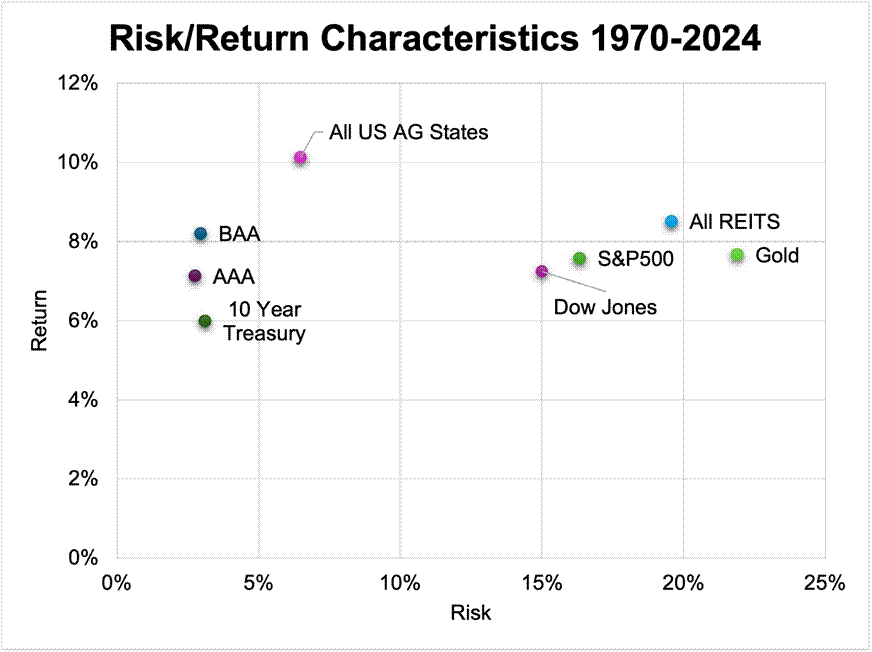
Under OZ 2.0, the introduction of Qualified Rural Opportunity Funds (QROFs) significantly enhances the appeal of these investments:
- 30% Basis Step-Up: QROF investments receive a 30% basis increase after five years, compared to 10% for standard funds.
- Lower Improvement Threshold: The "substantial improvement" requirement for rural OZs is reduced from 100% to 50%, facilitating easier entry for projects like large-scale drainage tiling and grain storage.
Downstream: Qualified Production Activities
Beyond the soil, Promised Land sees considerable potential downstream of the farm in Qualified Production Properties (QPP). Under the OBBBA, QPP incentives can be applied to the "substantial transformation" of agricultural products. Examples include:
- Dairy Milking and Processing Parlors
- Grain Milling or Processing Plants
- Poultry Slaughter and Beef Packing Houses
An Opportunistic Frontier: Critical Minerals
Further afield of the agricultural sector, where we might apply a more opportunistic approach is the "Resource-Rich" real assets that are required to power modern economic activity, such as lithium, rare earth elements, and Dr. Copper. McKinsey identifies resource-rich regions as ideal for specialized mining growth, such as Missouri's tech hub for critical minerals processing, which is projected to create $34 billion in economic value.
By combining rural OZ tax benefits with a strategic focus on critical minerals—as explored in Servant Financial’s recent blog series—investors can target the "chokeholds" of the global supply chain, turning remote rural areas into potentially vital pillars of national security. Some of these resource rich rural OZs may have a common feature like Winslow, Arizona, a rail line and station.
Winslow Station is a historic railroad depot located at 303 East Second Street in Winslow, Arizona, serving as the primary Amtrak stop for the city and an integral part of the adjacent La Posada Hotel complex, which together form a key landmark along former U.S. Route 66. Winslow station serves as a flag stop on Amtrak's Southwest Chief route, operating daily between Chicago, Illinois, and Los Angeles, California, providing eastbound and westbound service to connect passengers across the Midwest, Southwest, and West Coast. Freight traffic over the years centered on lumber from northeastern Arizona forests, such as Ponderosa Pines, and livestock shipments, including cattle and sheep from Navajo County ranches.
The Winslow station's prominence in popular culture stems from the 1972 Eagles song "Take It Easy," which famously includes the lyrics "standin' on a corner in Winslow, Arizona." Although the song references a street corner rather than the station itself, it captures the many rural American towns’ quintessential rail, agricultural, manufacturing, and mineral resource heritage and that laid-back vibe and peace of mind often found on main street.
Resources:
Author: John Heneghan
If you enjoyed this article, check out this other article about Opportunities:
2026 U.S. Farmland Values