
2026 USDA Land Values Summary
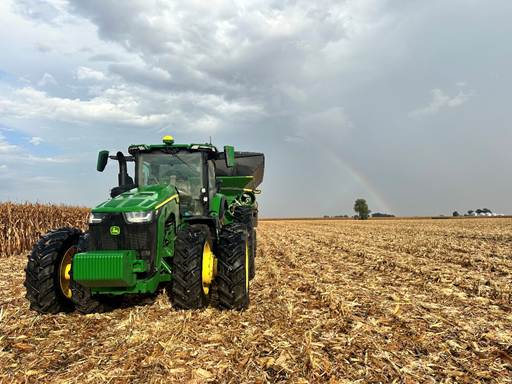
Another fall season is upon us, and with it comes cooler temperatures, the return of football, and harvest time for farmers across the United States. Harvest on my family farm began this past week in Illinois. So far, yields are off to a strong start, but with the varied weather patterns across the Corn Belt this year, that may not be the case for every farm. Unfortunately, a little rain meant we had to pause harvest, but it also made for a beautiful rainbow over the farm.
Fall also brings another USDA National Land Values Summary. Each year, this report provides some important benchmark metrics for evaluating where farmland values are headed across the country. After several years of record growth, the latest numbers aren't necessarily surprising. Farmland values continued to increase in 2026, but there is an important distinction: land values are still rising, but the pace of growth is slowing.
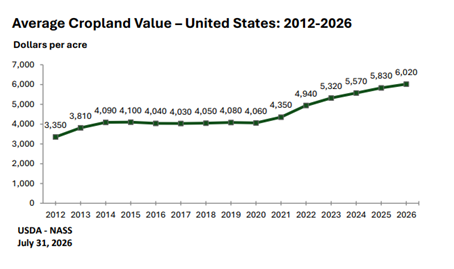
According to the USDA's 2026 report, the average value of U.S. cropland reached $6,020 per acre, an increase of 3.3% from 2025. This is the first time the national average cropland value has surpassed $6,000 per acre. Farm real estate — the all-land average of cropland, pasture, and buildings — increased 3.4% to $4,500 per acre, while pastureland increased 4.2% to $2,000 per acre.
The continued appreciation is notable given the current agricultural environment. Commodity prices have been volatile, farm margins remain under pressure, and higher interest rates have made farmland more expensive to finance. Despite these challenges, demand for quality farmland has remained strong, continuing a trend that has pushed land values substantially higher over the past several years.
Cropland Values Continue to Rise
The 2026 numbers continue a multi-year trend of increasing farmland values. However, the rate of appreciation has moderated. Cropland values increased 4.7% in 2025 compared with 3.3% in 2026. In other words, farmland values are still moving higher, but the pace of that growth has slowed.
That may not sound like a dramatic difference, but it is an important shift after several years of particularly strong appreciation. As the market becomes more normalized, factors such as farm income, interest rates, land productivity, and local demand may play a larger role in determining where individual properties trade.
Source: USDA
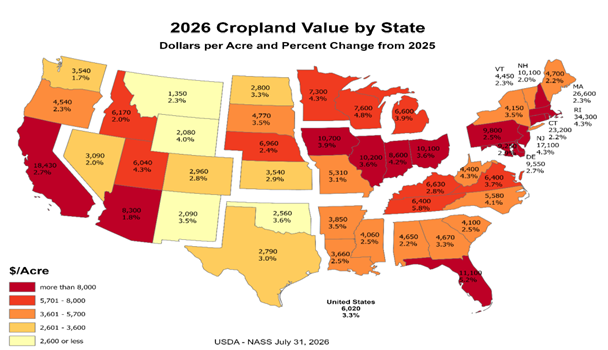
Regional differences also remain significant. The Corn Belt continues to represent some of the most valuable cropland in the country, with an average cropland value of $9,280 per acre in 2026. Illinois averaged $10,200 per acre, while Iowa reached $10,700. Ohio averaged $10,100 per acre and Indiana $8,600.
Source: USDA
These figures illustrate an important point about the national USDA average: farmland is not a homogeneous asset. Soil quality, productivity, location, water availability, field characteristics, and local tenant demand can all have a meaningful impact on the value of an individual property. For investors, this distinction is particularly important. The $6,020 national average is a useful benchmark, but it does not necessarily reflect the value or investment characteristics of the highest-quality farmland.
On the same USDA map, Mississippi cropland averaged about $4,650 per acre and North Carolina about $5,580 — well below both the $6,020 national cropland average and the Corn Belt. That is the “not homogeneous” point in Promised Land’s own geography.
How Long Will This Trend Continue?
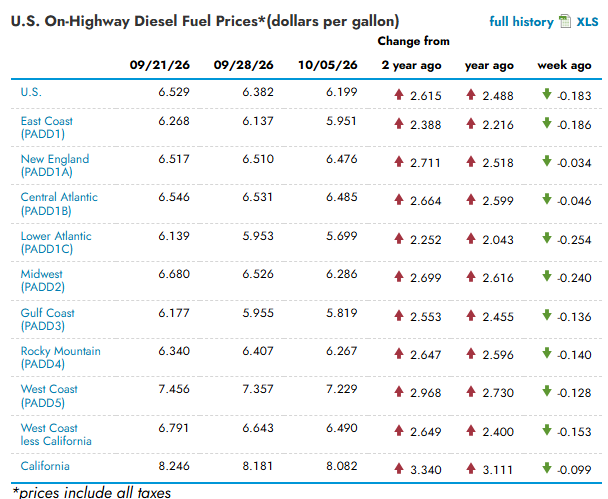
Will land values continue to rise, or are we heading toward a period of flat or declining values? That is the million-dollar question on many agriculturalists' minds. Historically, farmland values have been closely tied to farm income and commodity prices. Farm income has been squeezed over the past couple of years, and 2026 is expected to remain a challenging year for many producers due to lower commodity prices, tariff pressure, and higher input costs.
Diesel fuel and fertilizer are two good examples. These costs can have a significant impact on farm profitability, particularly during harvest when farmers are constantly fueling combines, tractors, trucks, and other equipment.
Source: U.S. Energy Information Administration
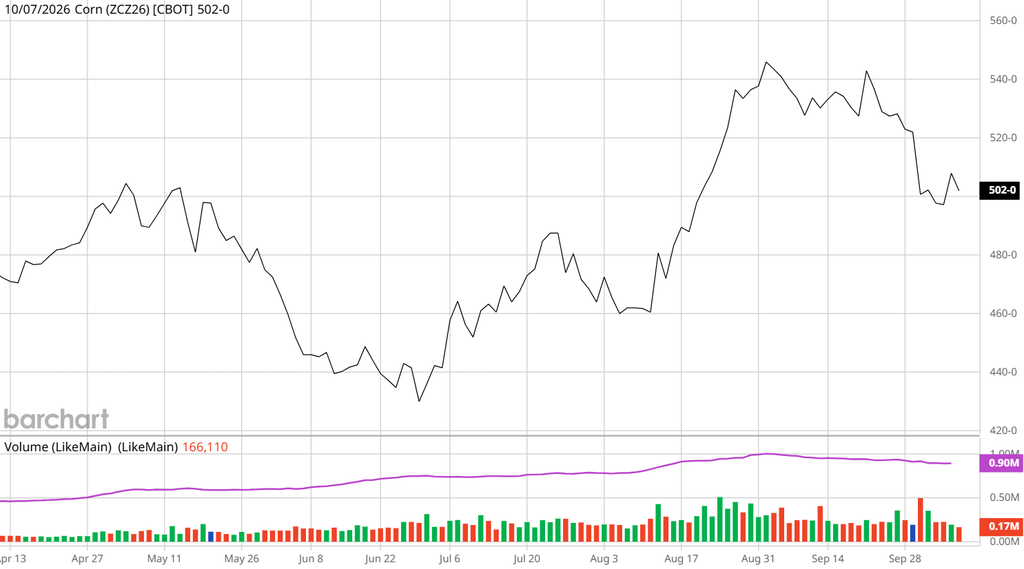
Farmers are hoping to see continued improvement in commodity prices to help offset some of these increased input costs. So far, corn and soybean prices have been rallying from their summer lows, providing some much-needed relief as farmers continue to face higher input costs.
December 2026 Corn Futures as of 10/7/2026
Source: Barchart
But farmland is influenced by more than the income it generates in a single year. Limited supply, long-term expectations for agricultural production, strong farmer balance sheets, and competition among farmers and investors can all contribute to sustained demand.
There is also a fundamental supply constraint. Unlike many other investments, the supply of productive farmland cannot simply expand when demand increases. The amount of high-quality agricultural land is finite, and the best properties rarely come to market. This scarcity can help explain why high-quality farmland has continued to command strong prices even when agricultural fundamentals have become less favorable.
At the same time, the moderation in appreciation suggests that buyers are becoming more selective. With higher acquisition costs and more challenging farm economics, the underlying productivity and income-generating potential of a property become increasingly important.
What Does This Mean for Farmland Investors?
For farmland investors, the 2026 report reinforces the importance of focusing on quality rather than simply relying on broad market appreciation.
When land values are rising rapidly across the country, it can be easy to view appreciation as the primary driver of returns. But as appreciation moderates, the characteristics of the individual asset become increasingly important.
USDA’s companion cash-rent survey put U.S. cropland rent at $160 per acre in 2026, $1 below 2025, even as cropland values rose 3.3%. Slowing appreciation plus a flat-to-down rent print is why individual farm income, not the national land index, should do more of the work from here.
High-quality soils, strong historical yields, reliable water resources, favorable locations, and strong tenant demand can provide a foundation for long-term performance. Properties that can generate attractive rental income while maintaining the potential for long-term appreciation may be particularly well positioned as the market enters a more normalized period.
This is one reason we continue to focus on high-quality farmland at Promised Land. Rather than trying to predict short-term movements in land prices, our strategy is centered on acquiring productive assets in markets with strong underlying agricultural fundamentals. This focus will be especially important as we evaluate new opportunities under Opportunity Zone 2.0, where the quality and long-term fundamentals of each investment will be critical over the OZ required 10-year hold period.
Author: Ailie Elmore Burd
If you enjoyed this article, check out this other article about Opportunities:
Harvesting Potential in Rural American OZs: U.S. Treasury Update on OZ Tax Incentive