
Promised Land Sets Sights on 2.0 Opportunity Zones
The American Heartland is standing at the threshold of a historic rural investment boom. With the passage of the One Big Beautiful Bill Act (OBBBA), Opportunity Zone 2.0 is no longer just a concept—it is a high, precision GPS-guided, 48-row planter behind a 500-horsepower tractor sowing seeds for the next great rural American renaissance. At Promised Land, we aren't just sitting idly by waiting for the OZ map to change; we are preparing for more favorable weather and an expected optimal investment climate ahead for rural OZs. We are aligning investor capital with the abundant, fertile growing regions across the country to ensure that American farming communities remain a vibrant backbone of our national economy.
Opportunity Zone 2.0 is in the early stages of its program rollout and Promised Land OZ is well-positioned to lead the educational and community engagement aspects. As we mentioned in our blog post, OZ 2.0 Takes Aim at Rural America, the Opportunity Zone Program was extended under the OBBBA on July 4th, 2025. The program extension establishes a permanent framework for opportunity zone investment with special incentives for investments in rural opportunity zones. While standard, non-rural Opportunity Zones offer a 10% step-up after a mandatory 5-year capital gain deferral period, the OBBBA has been designed to supercharge rural OZ investment. By offering a 30% step-up in basis, the federal government isn't just inviting investment—it’s issuing a mandate for revitalization of the American Heartland.
States and Federal Government Timeline
As the State Governors and the U.S. Treasury begin working through the OZ tract designation and certification process for Opportunity Zone 2.0, Promised Land is preparing to seed the next generation of rural growth by efficiently deploying investor capital at the program’s kickoff on January 1, 2027. Promised Land has a consistent track record of effectively deploying capital in farmland located in rural OZ communities. As the next generation of designations approaches, we are taking a proactive approach to ensure we are ready to move quickly to invest in farmland located in existing OZ 1.0 tracts and the OZ 2.0 cohort once these new tracts are finalized. Both OZ 1.0 and OZ 2.0 designated tracts qualifying as “rural” will be eligible for the 30% step up benefit.
From the timeline outlined below, state governors are quickly approaching their 90-day window to submit tracts for OZ 2.0 designation. Promised Land has been working to be an integral partner to this process in several states. Our fund manager, John Heneghan, accepted a seat on the Illinois Department of Commerce and Economic Opportunity (DCEO)’s Opportunity Zone 2.0 Ad Hoc Advisory Board. This actively positions Promised Land to continue its legacy as the leading rural development partner for Opportunity Zones located in American Farming Communities.
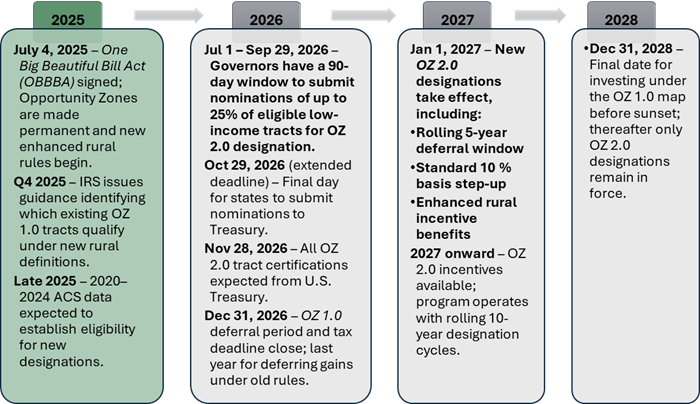
Activating the Pipeline for Rapid Deployment in 2027
In advance of the U.S. Treasury’s expected certification of new Opportunity Zone tracts, Promised Land is focused on expanding our sourcing network and deal pipeline to facilitate the rapid deployment of investor capital in 2027.
This includes engaging with potential partners, operating tenants, and prospective Fund III investors, while continuing to educate the broader investment community about the role Opportunity Zones can play in supporting agricultural land stewardship and rural economic development.
In January 2026, the Promised Land team presented during a breakout session at the Land Investment Expo in Des Moines, where we shared insights on Opportunity Zone 2.0 and its enhanced benefits for rural communities. In addition, John Heneghan attended the Novogradac Opportunity Zones Summit in December, delivering a similar presentation tailored to an investor-focused audience and highlighting how capital can be deployed effectively in rural Opportunity Zones.
Promised Land is also exploring other avenues to connect with our rural partners, such as attending the annual meeting of the Mid-South Chapter of American Society of Farm Managers and Rural Appraisers, and potentially sponsoring the 2027 FARMCON Conference hosted by Kevin Van Trump. Promised Land hopes to deepen its engagement with farmers who may have capital gains to reinvest, demonstrating how Opportunity Zone investing could provide a strategic way to put those gains to work.
At the same time, Promised Land is expanding its network of landowners, operators, and capital partners across agricultural regions. Through these relationships, the firm is identifying and pre-qualifying farmland assets that may fall within anticipated Opportunity Zone 2.0 boundaries. Our property pre-qualification strategy is discussed below. Preliminary diligence, property screening, and market analysis are being conducted to build a pipeline of potential acquisitions ahead of the designation deadline.
Post–November 28, 2026: Promised Land Deployment and Acquisition
Following the certification of updated Opportunity Zone designations by the U.S. Treasury, Promised Land will move to finalize property selections located within qualifying OZ 1.0 and 2.0 tracts.
With its acquisition pipeline flowing, the firm will advance full underwriting, finalize due diligence, negotiate, and execute purchase agreements on the most attractive farmland investments. The goal is to close on the highest priority farms in early 2027, positioning investors to benefit from OZ 2.0 program’s enhanced rural incentives, including the rolling deferral structure, 30% step up, and lower improvement requirements (50% versus 100%) for rural OZs.
Through this phased approach, Promised Land aims to remain at the forefront of rural Opportunity Zone investment, deploying patient capital into American farming communities while advancing long-term land stewardship practices and agricultural productivity.
Promised Land’s Pre-Qualification Strategy
To move at the speed of the market, we’ve standardized our vetting process to achieve two critical goals: education and execution. First, prequalification guidance will help educate the broader agricultural and investment community about the applicability of Opportunity Zones to farmland. Second, this guidance provides our partners with a practical framework for evaluating farmland properties and their suitability for OZ improvement requirements before presenting them to the Promised Land team.
The checklist allows partners to evaluate properties as they come to market and organize key information before submitting opportunities for underwriting review and valuation.
We’ve distilled years of institutional expertise into a streamlined 15-minute diagnostic. This isn't just a form; it’s the quickest path for our partners to move a 'potential lead' to 'actionable asset' before the ink on the Treasury's new maps even has a chance to dry. The checklist includes sections covering a property overview, Opportunity Zone qualification, potential development opportunities, a snapshot of the surrounding local economy, physical and soil characteristics of the cropland, and the qualifications and track record of existing tenant operator. Our hope is that this process empowers our partners to efficiently evaluate potential opportunities and forward the most promising properties to the Promised Land team.
The Property Overview section captures the basic information about the asset, including its location, asking price, acreage, and primary crops grown. We also ask partners to indicate whether they have an existing relationship with the property, whether through local familiarity, prior operating experience, or current management responsibilities.
The next section evaluates whether the property’s location qualifies under either Opportunity Zone 1.0 or Opportunity Zone 2.0. The existing Opportunity Zone 1.0 designations have been in place for several years, while the updated 2.0 designations are currently in development and expected to be released later this year. Fortunately, organizations such as Economic Innovation Group and Novogradac have developed tools that help determine whether a tract is likely to qualify under the updated Opportunity Zone 2.0 eligibility guidelines.
The central objective of the Opportunity Zone program is to drive private investment into lower income communities and census tracts that are starved for economic development. For farmland assets to align with both the program’s goals and Promised Land’s investment philosophy, properties must present a clear value-add improvement opportunity. Examples may include installing drainage tile, expanding or adding new grain storage capacity, adding irrigation systems, or making other capital improvements that increase the land’s productivity capacity and long-term value. Our partners, who often have deep local knowledge, are frequently better positioned to evaluate many of these development opportunities. Additional sections of the form ask partners to document a farm’s existing improvements and soil characteristics to help establish the property’s baseline condition for valuation purposes and determining whether further investment may be warranted and economically beneficial to farmer tenants.
Another important component of the evaluation process is the local economic environment of the property. Farmland located near key delivery points, such as export facilities, processing plants, or major crop offtake centers, often benefit from stronger long-term demand and logistical advantages. Our partners assess each property’s proximity to these critical infrastructure assets, along with general observations about the local agricultural economy, depth of potential tenant base, and competitive dynamics within the market.
The Path Forward
The Promised Land team is currently sharing this pre-qualification framework with its partnership network while educating the broader economic development community about the role Opportunity Zones can play in farmland investment. By combining a disciplined screening process with strong on-the-ground partnerships in these communities, Promised Land is building a scalable process aligned with the economic development goals of the Opportunity Zone program and the long-term benefits of committed stewardship of productive agricultural land.
Just as a 500-horsepower tractor prepares the field for a bountiful harvest, Promised Land is laying the groundwork for a new era of rural prosperity. As OZ 2.0 takes root, we remain committed to our mission: channeling patient, purposeful capital into the heart of rural America. Together with our partners, we are cultivating a legacy of responsible stewardship and robust economic growth that will sustain the American Heartland for generations.
Article By: Ailie Elmore